
Steam Deck OLED Review
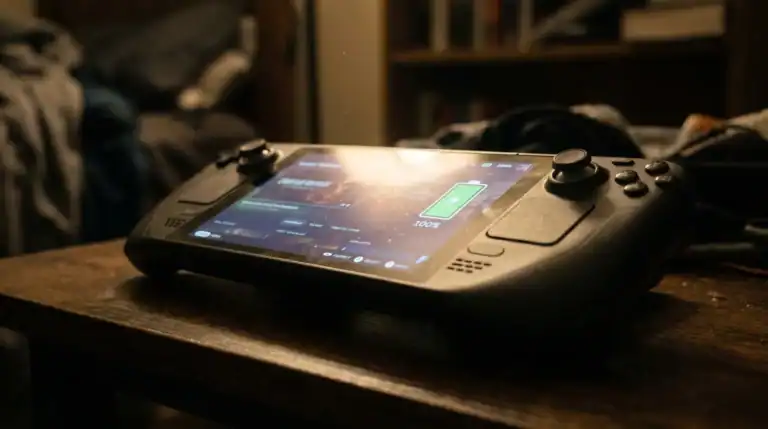
The Steam Deck OLED is the second-generation Steam Deck, Valve’s upgrade released in late 2023 that replaced the LCD panel with an OLED display, increased the battery from 40Wh to 50Wh, and dropped the weight from 669g to 640g. Two and a half years later, it’s still the best version of the Steam Deck and one of the most compelling gaming handhelds available.
Steam Deck OLED Specs
| Spec | Steam Deck OLED |
|---|---|
| Display | 7.4-inch OLED, 90Hz, 1280×800 |
| Processor | AMD APU (Zen 2 + RDNA 2, 6nm) |
| RAM | 16GB LPDDR5 |
| Storage | 512GB or 1TB SSD |
| Battery | 50Wh |
| OS | SteamOS |
| Weight | 640g |
| Price | From $549 |
The OLED Display
The display upgrade from LCD to OLED is the Steam Deck OLED’s defining improvement. OLED panels turn off individual pixels to produce true black, no backlight means no bleed, no haze in dark scenes. Dark games like Elden Ring, Hollow Knight, and Dead Cells look noticeably better. Colours are more saturated, and the larger 7.4-inch panel (vs the LCD’s 7 inches) gives more screen real estate.
The 90Hz refresh rate is a step up from the LCD’s 60Hz. Menus and game motion feel smoother, particularly noticeable in games that target 60fps or higher.
Performance
The OLED uses a 6nm version of the same AMD APU as the LCD (originally 7nm). Performance is nearly identical in gaming, within 1,3% in benchmarks. The efficiency gain from 6nm helps battery life rather than raw frames. The OLED is not faster than the LCD in any meaningful way.
Both models play exactly the same games at the same settings. If a game runs at 40fps on the LCD, it runs at 40fps on the OLED.
SteamOS
SteamOS is the Steam Deck’s greatest software advantage. Boot the device, tap a game, play. Proton handles Windows game compatibility automatically, over 90% of Steam games work without any configuration. The gaming mode interface is controller-native and fast. No Windows update prompts, no desktop UX designed for mice.
The limitation: kernel-level anti-cheat (Valorant, Warzone) doesn’t work on SteamOS. If you play competitive multiplayer games requiring those anti-cheat systems, you need a Windows handheld instead.
Battery Life
The 50Wh battery and OLED panel efficiency combine to deliver the best battery life of any Steam Deck model. Real-world results:
- Demanding AAA (Elden Ring, Cyberpunk 2077): 2-2.5 hours at 25W TDP
- Mid-tier games (Hades II, Dead Cells): 4-5 hours at 15W TDP
- Light games / streaming (Stardew Valley): 6-7 hours
Is the Steam Deck OLED Worth It Over the LCD?
The OLED costs $150 more than the LCD for 512GB storage. The improvements are real: better display, longer battery, lighter weight, and a slightly faster chip for efficiency. For most buyers starting fresh, the OLED is the right purchase if the budget allows.
The LCD remains a good device, the performance is identical and it still plays every game. If $399 vs $549 is the deciding factor, the LCD is still worth buying.
Where to Buy
Bottom Line
The Steam Deck OLED is the best gaming handheld under $600 in 2026. OLED display, 50Wh battery, SteamOS, and access to thousands of Steam games, at $549, nothing else at this price comes close for PC game compatibility and polish. The ROG Ally X beats it on raw performance and Windows compatibility at $799; the Nintendo Switch 2 beats it on Nintendo exclusives at $449. For Steam gamers, the Deck OLED is the answer.
👉 Check Steam Deck OLED on Amazon
8 Comments